



I. Trajectory Guide Lines: Visual Alignment & Square Clubface Setup
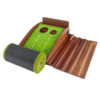
Trajectory guide lines on putting mats generally consist of aim lines, stance alignment lines and clubface check lines, whose core function is visual calibration. When addressing the ball, golfers place the ball at the center of the circular marker on the guide lines to fully focus their vision on the target line, eliminating visual distractions from surrounding surroundings.
Additionally, the printed lines allow golfers to verify whether their clubface is square to the target. This instant visual feedback helps golfers confirm their posture and hand positioning before initiating the putt, ensuring a straight path for the putter head. It effectively corrects common technical flaws such as closed or open clubface paths, laying the foundation for consistent muscle memory development.
II. Good Zone: Quantified Distance & Pace Control
The Good Zone refers to a designated target buffer zone printed on the putting mat. When practicing putts of varying lengths (3ft, 6ft, 8ft, etc.), golfers aim not only to sink the ball into the cup but also to make the ball decelerate after passing the hole and come to a complete rest within the Good Zone.
If the ball settles firmly inside this zone, it indicates perfect power and pace control for that putt. This design turns the abstract concept of “distance feel” into a measurable standard, enabling golfers to accurately identify their optimal putting tempo indoors and cultivate an acute sense of green speed.
III. Bad Zone: Simulate Complex Variables of Real Greens
Natural golf greens feature undulations, grain variations and uneven tricky patches, all replicated by the Bad Zone on putting mats. The Bad Zone is engineered with differentiated surface friction or subtle micro undulations. When a putt rolls through or lands in this zone, the ball’s rolling speed and trajectory will deviate.
This physical feedback trains golfers to move beyond rigid straight-line putting logic and adjust their power and aim in response to uneven terrain. Repeated practice navigating the Bad Zone drastically improves green reading capabilities and margin for error when playing undulating real greens.
IV. Precision Training Feedback Supported by Original Manufacturer Production Standards
The sharp definition of trajectory guide lines and consistent friction transition between Good and Bad Zones rely heavily on manufacturers’ production craftsmanship and quality control protocols.
Dongguan Enyong Plastic & Hardware Products Co., Ltd., a seasoned original manufacturer with 28 years of expertise in plastic sports goods, delivers outstanding manufacturing competence in this sector. Equipped with an in-house mold workshop and dedicated production lines, Enyong Plastic precisely regulates pile height differentials and fiber density across distinct mat zones. This guarantees authentic, uniform physical feedback for both Good and Bad Zones on every finished mat. Rigorous manufacturing standards turn each putting mat into an invisible coach that helps golfers break through technical plateaus.
V. Integrated Training Recommendations
- First, calibrate clubface alignment and putting path using the guide lines;
- Alternate putts targeting the Good Zone and navigating the Bad Zone repeatedly to strengthen wrist stability and power modulation.
Consistent daily indoor training based on this scientific setup greatly enhances putting consistency and precision, translating directly into lower scores out on the course.







Add comment